
A few weeks ago I ran an extensive test of a number of free analytic tracking packages. Hopefully nobody noticed the added load time from the extra scripts being run? It’s taken me a few weeks to find the time to write up the results but I think they provide some very valuable insight. I think it should be stated that coming into the test I was very commited to Google Analytics.
I installed the code and tested the following services for 20 days. Some of these services were only for free trials. The write-ups below provide a little more information about each service and some conclusions I came to during the testing.
The Free Services
BlogTracker -  I’m actually quite impressed by the amount of data provided. Would like to see some information about unique visitors, bounce rate, and time on site, but otherwise this is a fairly comprehensive site analytic package for a blog. There is also a good bit of customizable options for viewing data on your own time rage and different graphing options. There are also exporting options. BlogTracker also tells you your ranking on the IceRocket network which is an interesting guage. The service even provides some live data of your most recent visitors although this is truly only useful if you are constantly in the system watching.
Clicky -  This is a pretty cool tracking service. It does allow real time tracking which is a VERY nice feature. Also Clicky can pull in your Feedburner data which is an added perk and something that none of the other services I tested provide. It should be noted that Performancing metrics seems to be an exact or very close exact copy of Clicky. I haven’t test it so I’m not exactly sure. To give you an example I stumbled a post on my site and then set back and watched the hits roll through the Clicky AJAX web interface without needing to refresh. It was pretty mind-blowing. Clicky’s biggest downfall is in it’s inability to let you view data in customizable ways. The ranges are limited to week, month or year ranges, but if you wanted to look at data two weeks ago and just that week you couldn’t do that. It is one of the prettiest looking services. The Clicky code also puts a graphic on your page which was kind of a turnoff.
CrazyEgg - This site does let you start off with a free account, but limits what you can do. Crazy Egg specializes in Heat-mapping. This service is great if you are looking to optimize your site and wanting to gather data over a month period. The free service is for a month and allows you to track up to 5,000 visitors. For a small site looking to optimize a site this is perfect. This service is also valuable to run a limited study of a site or page. (See Crazy Egg Snapshot)
Enquisite - This tool allows you to track and monitor search trends. It is a nice supplement to Google Analytics. The data that is provided is a little confusing and as it builds over time can get overwhelming. Also the interface looks a little dated, which although for hard core number crunching doesn’t matter, I find it sometimes hard to figure out what I’m looking for. Because the filters aren’t fully customizable it can take a little extra work to find exactly what you are looking for. This is definitely an advanced tool only for the most serious of search engine marketers.
UPDATE: Since I ran the study Enquisite has updated their tools to a much more graphically appealing interface.
Google Analytics -  This is a must install for anyone serious about tracking web traffic. Google Analytics provided the most complete assortment of data of any of the services. The biggest noticeable absences are no live tracking data (data is compiled on regularly intervals and is best to look at daily data) and the absence of RSS feed data. Considering Google now owns Feedburner this only seems like a natural addition and something that one would think would have be implemented in the future. This truly is an enterprise level analtyics package with a can’t miss price point.
MyBlogLog -  Besides the community aspect that MyBlogLog allows you to build this site also allows you to track your site stats. The free statistical data provided only provides data up to a week. The upgrade service is only $3/month or $25/year. Even then it doesn’t look like there are many reports that you can run with the system. I was only able to see a referrer, pageviews, out clicks, and daily summary reports of the above. This data is useful for quick data summaries about what happened on your site in the last week, but that is really it. A nice feature is by having their widget installed, see sidebar for mine, is all you need to install for the tracking code. What is really neat about this is you can see specific members of the community who visit your site and connect with them. Because these individuals are almost always other blog owners it’s interesting to visit their blogs and see what type of blog writers are visiting your site. This feature definitely provides you with more individual specific data than any other service.
SiteMeter -  SiteMeter does send you nice weekly reports, but I have to admit the reports are very limiting. The intro screen has basic information, but it is difficult, if not impossible to find specific data that you might be interest. Search result data is not provided nor is compiled data about specific page hits. Also you are limited in some of the reports that you can run to weekly, monthly, or yearly. The Site Meter code also puts a graphic on your page.
Statcounter -  The free version has a log limit of 500 entries as you can image this service quickly becomes useless. The only data that is provided in bigger bulk is Hits, and some visitor data. Otherwise everything else is a very small sample and not useful. This service does look like it could have potential if you are willing to pay as it offers exporting options and multiple graphic views. There is also customizable data ranges available. Unfortunately it is impossible to say how useful these tools are without purchasing a plan. Pay plans work by the size of your log. If I was able to fill up a relatively small site log in less than three weeks and a log quota of 100,000 (the largest listed) runs $499/year this could quickly be an expensive service.
Quantcast -  This is a great resource for gathering analytical data about a site. What makes it unique is the demographic data that it pulls. I have no idea how accurate this information is, but it is really interesting. Although this data won’t be very useful for you to drill down, it does provide some trend data and should be used for such. The interesting thing about Quantcast is they gather data about sites whether you have the script installed or not. I don’t know how much more accurate your installing the script helps?
WebSTAT -  Although they offer plans that cost money they do offer a Basic edition that is free up to 20,000 visits per month. There are many customizable option that does return many reports. A few things that I’m really surprised is missing is referring sites, time on site, and bounce rate. Knowing where your traffic comes from and how long they stay are two important metrics that I’m surprised are missing. There are nice graphing and customizing options in the system. I also like the ability to export your data. The WebSTAT code puts a graphic on your page.
WordPress.com Stats - For some reason this data never seemed to display for me? I don’t really know what the deal was?
The Data
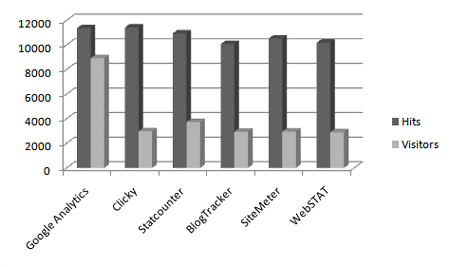
The above graph shows a comparison of two of the stats that seem to be the only standard provided across the services. As you can see the data over the twenty days shows pretty similar data of Hits across the experiment and only Google Analytics varied greatly when looking at visitors. What this data tells me is that it doesn’t look like it really matters which service you use as they all provide pretty similar data. What really makes the difference is deciding what additional measurements besides hits and visitors is important to you. It is because of these other reports and measurements that Google Analytics really stands out above the rest despite. I am a little confused by the difference in Google Analytics visitors? If anyone has any ideas why absolute visitors in Google Analytics is so much higher I’d love to hear them?
Conclusion
Besides the fact I’m a converted Google Analytics user, the results definitely supported my belief. After everything I kept Google AnalyticsBlogTrackerQuantcast and the MyBlogLog widget. Clicky was one that I seriously considered keeping but the added graphic wasn’t something that I wanted to keep on my page and I felt the BlogTracker provided the live tracking service that had me seriously considering keeping Clicky.
Extra Note: Before removing the scripts I ran WebSiteOptimization.com’s Web Page Analyzer just to see how much additional load all these scripts were putting on my page loads. This additional load accounted for about 16% or 52,367 bytes (roughly 51KB). I would highly recommend Web Page Analyzer as a tool to see how long it takes your pages to load and to better understand how to optimize pages on your site to load quicker. If you are really interested here are pdf’s of the WebSiteOptimization.com result pages with the Analytic Code and without the Analytic Code.
Additional Resources:
- Top 5 Web Analytics Apps that are better than Google Analytics - I just read this today and although I don’t agree with the author I think it’s important to present another view.
- 20 Analytics Tools For Blogs - I discovered many of the tools I used for this study off this post so it’s only fair to give some credit.
- Free Website Analytics Tracking Resources - This is a page I’ve put together with the resources mentioned in this post along with some others that provide industry data and can be used to analyze your competition.
Thanks for all the work on this, Kyle. Really helpful to see a comparison and your conclusions.
Wow, this is an extremely in-depth post and provided some very valuable information vital to choosing which analytics services to use. Thanks!
Wow. 11! Thanks for going through the testing process and posting about it. I’ve been using Statcounter and Google Analytics for quite some time now on my personal site. I pay for a bit more log space for Statcounter. I like that it provides up to the minute info.
PS: heatmap analysis is such a great way to show people a visual representation of what users are actually clicking…love the crazy egg!
The unfortunate part is Google Analytics is really a service the paid companies charge for - though many will soon drop away.
If you want the real robust stuff you have to go paid… use GA until you make enough to drop it… if you are in a competitive space they will share the aggregate info and you are doing work for the newer people in your space.
Great post. Quantcast doesn’t really fit. It’s more in the Compete.com / Alexa category and not really a web analytics solution.
@ Dennis and Erica - Thanks guys I’m glad the post was helpful.
@ Eric - Heat-mapping is awesome! I think next time I’m going to use it more to examine a specific page to better learn what is going on. It doesn’t really work so well on the front page of a blog that is constantly being changed and updated with new posts being added.
@AussieWebmaster - I agree with you about the paid stuff being the top of the line services. I think what is important to note is that if your someone new to Web Analytics it’s probably best to start with some free services to understand what pieces are more important to your needs than others. This way when you go to purchase an enterprise solution you know exactly what is important to you. Hands down GA is the best of the free services and can provide a lot, but it’s still important to poke around some of the other services to understand what they offer.
@Webanalyticsbook - I would agree that Quantcast doesn’t quite fit in, but they do offer some free code for you to track your site. Do you have any idea how much more accurate installing their code on your site makes your Quantcast profile? They provide some excellent demographic data, but I have no idea how accurate it is and if installing the code helps any in that.
Next time you can give a try to the promising open source web analytics piwik https://piwik.org
(open APIs, plugins APIs, lots of interesting features
@Matt - Cool! I haven’t heard of piwik. I’ll definitely set that up and give it a test run.
Just taking a quick peek I like the site and your claim to be a Google Analytics alternative is ambitious, but intriguing. Thanks!
“It should be noted that Performancing metrics seems to be an exact or very close exact copy of Clicky.”
Clicky offers a white label service. So it could well be Clicky but in different clothing, so to speak.
“Considering Google now owns Feedburner this only seems like a natural addition and something that one would think would have be implemented in the future.”
Agreed. A major irritation, something I’ve written about before, too.
Thing is, Feedburner has its own web statistics, but they’re flawed. From a statistical point of view, it’s pretty good for what it is, but it essentially treats visits and hits in the same way, which is a little strange.
As for MyBlogLog, I was a paid subscriber, but I find MyBlogLog to be quite poor, so I let my payment lapse. Also, I stopped using their Widget ages ago, right after I saw an avatar which was a huge pair of tits.
I’m a paid user of Clicky, which I really like, while I use Google Analytics for the long-term trend stuff.
What about Mint? There was a lot said about Mint at the time of its launch.
Solid review, Kyle. A good resource…
Yeah Mint… I completely forgot about that one. Looks like I’ll have to run another test here in a few weeks to compare Mint and Piwik.
Wayne, I think the only reason I keep MyBlogLog installed is a little vanity thing. You can see exact individuals who visit your site. If everyone left comments you wouldn’t need to worry about it, but it’s just kind of cool to see specific people who come and read your stuff. Also because the MyBlogLog community is mainly other bloggers it can be an interesting way to find new blogs to read.
Thanks for this study, I really do like Clicky, but the cost is around $50 a year, and I probably won’t renew.
I like Sitemeter as for the free choice.
Take a look at W3Counter some time.
Reinvigorate is pretty amazing
https://reinvigorate.net/
Nice post Kyle
I am guessing that by ‘hits’ you are referring to pageviews? Also it would be good to clarify if by ‘visitors’ you are referring to unique visitors or perhaps visit sessions?
Another multi-tool study that may interest you is that done by Eric Enge over at Stone Temple: https://www.stonetemple.com/articles/analytics-report-august-2007.shtml
Also I have an accuracy whitepaper which discusses in detail the abilities and limitations of comparing web analytics tools:
https://www.advanced-web-metrics.com/blog/2008/02/16/accuracy-whitepaper/
I would be interested in your comments.
HTH, Brian
I have been using Mint and Google Analytics and the results have a lot of difference. At the end of the day with Analytics you can only keep track of traffic trends and really there is no Analytic software which can give you perfect traffic score.
Thanks for sharing these 11 great analytics resources… I personally have just been using Google Analytics and my hosting packages webstats… but I may be interested in using more than one to compare data because sometimes could be innacurate…
What an awesome article! We are a web analytics consulting company and a GAAC (Google Analytics Authorized Consultancy) and we have gained alot of value out of this post.
I cant wait to go and check out some of these sites and toolsets! Cheers mate!
What an awesome article! We are a web analytics consulting company and a GAAC (Google Analytics Authorized Consultancy) and we have gained alot of value out of this post.
I cant wait to go and check out some of these sites and toolsets! Cheers mate!
Google is the only one I’d consider using. Nice to know about the others but I love Google Analytic.
Kyle, I’ve read such report:
“When You are on the site for a long time without any action (for example 31 minutes) and then begin to act - trackers think that it is two different visitros”
24]они мечтают поиметь член каждой влажной дырочкой
Игривая непоседа секс нудизм видео Непрерывные ласки язычком, горячих дырочек малышек секс душем видео
Шикарные кадры звездной распущенности - эти девушки не знают, когда пора остановится в преследовании своих самых страстных желаний. видео групповой секс галерея Комната грехов
Тетки страстно стонут от удовольствия, когда им прочищают киски. как правильно ебать в жопу Посмотри как надо забивать в эти упругие попки и мокрые киски! Эти девочки любят когда кто то ебет их как в форме футболистов. самые большие коллекции порно видео
Человек в маске контакт порно смотреть Большие игрушки возбуждают этих девчонок не хуже вида мужского достоинства, - они настоящие мастерицы поиграть в эти запретные игры.
I really like Clicky - mainly because its all done in realtime which is essential for running my kind of site.