
 Website Grader is one of those excellent free resources that I run on sites about once a month. In it its own words:
Website Grader is a free seo tool that measures the marketing effectiveness of a website. It provides a score that incorporates things like website traffic, SEO, social popularity and other technical factors. It also provides some basic advice on how the website can be improved from a marketing perspective.
This tool is especially well designed to fit right into a University web developer tool set. Some of the basic measurements reported include:
- Metadata Information
- Age of Site
- Google PageRank
- Indexed Pages
- Last Google Crawl
- Traffic Rank
The report that is compiled is an excellent starting point to make sure that your site rates well for basic search engine optimization practices. The information that returned isn’t overwhelming, but just about right for a quick scan about what’s going on with your site. You can also do a little comparative analysis with direct competitors websites. You could check out a recent report I pulled for Wofford, but I would recommend simply heading on over and running a Website Grader report for your own site. It cost nothing and stores the report in their system sending you an email for quick and easy reference.
You can also pull reports on a regular basis, I recommend monthly, and see site trends. In fact that is one of the best reasons to use a tool like this. The first time you run Website Grader there are going to be problems that stands out that you need to resolve. After making these changes and giving the corrections a little time to be picked up by the search engines you come back in a month and run the report again to see how your changes helped, or didn’t.
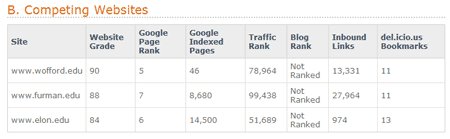
The report will also let you compare your site to competition that you choose.
A website is a constantly changing and adapting entity. It is easy to get so locked into what needs to be done on a daily basis that we don’t think about what we could be doing differently or better to keep our sites relevant. Website Grader is one of those tools that can help break that deadlock. It is a simply enough tool that only scrapes the surface, but usually that is all that we have time for and when the deeper scans are required it can be combined with other resources.
It is important to remember this is only a tool and even if your site scores extremely well this doesn’t mean that it’s time to enable cruise control. Director of Web MarketingGray goes so far as saying on his blog post, Why Website Grader is a Bad Idea:
Back to Website Grader, here’s my problem in a nutshell, there are somethings in SEO that you can automate, there are some things that you can’t and a site audit is at the top of that list. You can use tools to help you gather that data, sift through it, sort, arrange it, and dissect it anyway you want. At the end of the day you need an experienced analyst interpreting that data for you. You don’t want the SEO equivalent of a check engine light. There’s reason site clinics are so popular at search engine conferences, people need to expert advice on how to fix things from time to time.
I agree with the argument Director of Web Marketingis making, but I think using this tool is well worth the knowledge gained as long as you don’t assume you can just relax and not continue to develop a site in the event that you score high. In fact reading through his whole post I’m not sure he’s trashing the tool, just warning users that Website Grader is not an easy button for fixing a site and much more should go into a site audit.

Even sites that score really high have issues that can be further developed. Also keep in mind that a score is computed based on many measurements including traffic and social popularity, meaning you could have a very popular site with lots of visitors and buzz that scores well, but it isn’t optimized for search engines.
I’ve been pulling Website Grader reports since last September and I’ve noticed that the tool has grown and adapted which is another reason to regularly run reports. It isn’t a dead project so as the internet has adapted and new measurements are created to measure a site Website Grader adds them. So go give it a test run and while you are at it visit the rest of the HubSpot site. I highly recommend HubSpot’s Internet Marketing blog. So much of their posts easily translate to Higher Education marketing.
In closing I’ll leave you with a few of my favorite HubSpot posts for Higher Education marketers:
- Customer Service is Marketing Too
- How to Convince a CEO to Enter 21st Century Internet Marketing
- The New Rules of Marketing
- Marketing Metrics: What to Measure in Marketing - Part I and Part II
Great balanced post about WebsiteGrader.
You are very right. People shouldn’t obsess over their scores. There’s some “actionable” advice in the report.
But, to really improve their scores, they need an internet marketing plan that takes their business goals into account.
I ran my college’s site through and it provided some interesting information, nothing I didn’t already know. However, I tried to run my WordPress blog through it and it said it couldn’t grab it - my guess is Bad Behavior must of caught it and blocked it.
yup it’s not a horrible tool it’s that people are lazy and will say “hey I got a 90 … we’re good” and zip off to something else
you have a very good blog. this is my first visit to your blog.
It’s plain inaccurate on quite a few points, good for telling you how many Diggs you’ve got that hasn’t reached the home page.
Thanks for sharing this resource. I tested it out a few times and I think it is well worthy of a recommendation.
I agree that you don’t want to become overly dependent on such resources, but this can be very valuable when used properly.
Thanks to all for the feedback.
@Mike. Send me a link to your WP blog and I’ll see why it isn’t working.
@graywolf. The people that get higher scores can generally do even more. So, you’re right, it’s dangerous to think a “high” score means there’s not potential for improvement. In fact, I talk to companies with 1,000s of pages and 1,000s of links (two things that affect website grade score significantly) every week who have 90ish scores who have SO much more untapped potential.
@hobo. would appreciate you sending me an email with what is inaccurate, so we can address.
Email is firstinitiallastname at hubspot dot com.
I’m just curious what does hubspot do with the data it collects. how many sales guys are waiting to contact the poor sites that are ru n through this tool?
10/10 on a Lead generation tool for hubspot
must feel good following up on the sites that the freelancer is trying to make a living on in a dying economy.
@SEOinBlack
We actually work with many SEO firms.
And all of our sales professionals can hold their own with an SEO professional.
Not sure whether you’re jealous of our success or genuinely think that we are doing something wrong?
Just to allay the latter concern…
Website Grader does refer a lot of traffic to HubSpot’s website and blog where someone might opt in to receive information or a call.
We follow up with people who are looking to improve their internet marketing strategy and execution. Not everyone buys, but we do get to help many people. Our main service goes into a lot further depth at guiding our clients towards online marketing success leveraging SEO, blogging, PPC and social media, as well as best practices for lead capture.
Many times, we work with SEO consultants on mutual clients. Consultants bring us clients who want to collaborate on their SEO with their consultant (or if the consultant wants to have better tools and reporting in place) and we sometimes refer clients who need additional help to SEO consultants who have experience using our tools successfully.
We’d be happy to work with you if you are good. You should complete a demo request. We can see if there’s a fit or not.
I’ve created a mini audit tool that can aid in onpage optimisation. Just doing my bit for the SEO crowd.
Great tool.
We have suffered a bit with rankings very recently (it was almost an overnight thing) and the main issue that seemed to jump out at me was not renewing the domain name.
It had a month to go on the clock and I have a sneaking suspicion that this might be the reason our rankings have been suppressed by Google.
Obviously we renewed the domain name today! It will be interesting to see how or if our rankings bounce back as quickly.
Cheers.
Website Grader gives very good analysis and suggestion for seo
I began a virtual tour company https://www.regal360.com over 2 months ago. I started out as a grade 15, and within 2 months my grade was up to 84. I has been a great too in optimizing my site and increasing my traffic. I am also a member at seomoz.org they have excellent tools also.
Regards,
Terry
My fellow on Orkut shared this link and I’m not dissapointed at all that I came here.
p.s. Year One is already on the Internet and you can watch it for free.
I have found all these SEO audit tools helpful as I am fairly new to the optimising game. Thanks guys
Search Engine Optimization is really a tough job to do. Don’t you think so? But, Your blog contains good info on that. GOod work! Congrates! But, I take a little care for SEO about my websites. I do not want to spam this blog by discussing about my website. But for adding to your knowledge I would like to tell that I have made a wonderful tool for internet marketing. You do not need to SEO your website to get any traffic. You will get thousands of customers & referrals in few days only and this is GUARANTEED! and WITH NO EXTRA COST. You can see the proofs of INCOMES uploaded by the customers, there are many. NO SEO, Articles or anything is required. A TONS of reviews available with PROOFS! Again, Getting back to your blog, I would like to suggest something more, You have already done a great job. But, it would be more interesting if you add some more articles in it regarding sEO. What I like most in your blog and would appreciate from heart, is the simplicity of the language, Keep it up! Thanks for sharing such a great information. But would like to discuss one thing. How much do you think is the optimum cost of SEO? It does not matter you pay or not. But what it should be? Let this discussion going on. Waiting for your reply. - Thanks - Regards
I am trying this tool, but I want to know whether there are tools like this which have a better support to Chinese?
Cool software tips, looking for input on designing a new free SEO software suite.
enjoyed the read, i will bookmark your page and share it with my friends
Hi, loved the post but quick question…I had a little difficulty loading your page - I use firefox, do you think this was the problem…Bookmarked
Does this always apply?
Twitter has become so much fun to use, now that there are so many new tools to play with.
splendid work mate, reads very well
Hey,
I frequently check the status of my website at websitegrader.com. But it always says that i have no rss feed at my site, but I have. Can anybody sort me out with this. How do websitegrader will know that I have RSS on my website.
Hi there, I have just found your website whilst hunting around the Internet as I’m researching some material on engine lifts!. It’s a good website so I bookmarked this site and I will revisit you tomorrow to enjoy a proper read when I’m more free.
enjoyed the read, i will bookmark your page and share it with my friends
I am a new visitor to this site and wanted to take a moment to let you know that I think it is wonderful. I have subscribed to your rss feed and look forward to more of your great posts.
Thanks, I’ll come back again.
Hi, I found your blog on msn. I’m pretty happy to have found your blog because I think it is interesting! I will definitely come back! Great resource for my students. Youproblog
Website gradder grade your site in comparison to a normal site and provide with a result which you can show in your blog.
Super writing. You have gained a new devotee. Please keep up the nice posts and I look forward to more of your interesting writings.
Hi hun, sweet blog! I really treasure this post.. I was curious about this for a while now. This cleared a lot up for me! Do you have a rss feed that I can add?
Hi, just found this blog but I have to say that it looks nice. I fully agree with you. Have a nice day, keep up the great work and I will definitely keep checking your blog.I just got in to the BF BC2 PC Beta for free, check out this youtube video for instructions on how you can do it https://www.metacafe.com/watch/4122526/
Hi there, I came across your blog via Live search while looking for Harley davidson shift linkages and your post caught my interest.
Klasse Beitrag!Werde öfters mal vorbeischauen! Achja, falls ihr euch aktuelle Musik völlig legal & kostenlos runterladen wollt,schaut mal auf https://www.kostenlos-runterladen.net !
Howdy, artificial colored, specially from the major news corperations with the big slants to the left or right. Did you see last nights O’Rielly factor? haha, that was hilarious! Sorry, I’m rambling on again. Have a Wonderful day!
Excellent Website!
Find this blog fantastic. Hope to see it further when i have more time. If your looking for a job, visit our site.Thanks
This is nothing more that a way for the HubSpot folks to get your contact info and constantly try to email, write or call you selling their products. Constant spam!!!
After I told them to stop contacting me, they blocked us from grading our company website. Like they say, “Nothing is free in this world!”
Every time we now try to grade the site, it comes back saying we have to purchase the software!!
I recommend you do not use this service…………
Sehr interessant. Kommt hier noch ein weiterer Beitrag? Möchte sehr gern einiges mehr darüber hören. Könntest du mir per Mail antworten?
Great blog and post, keep it up i will be subscribing to your feed!